TTA Workshop Connects Families with Community Partners
For families of youth with disabilities, one question tends to hover over everything as graduation approaches: what comes next?
The services exist. The support is out there. But finding it, understanding it, qualifying for it, and actually accessing it can feel like a full-time job on top of everything else families are already managing.
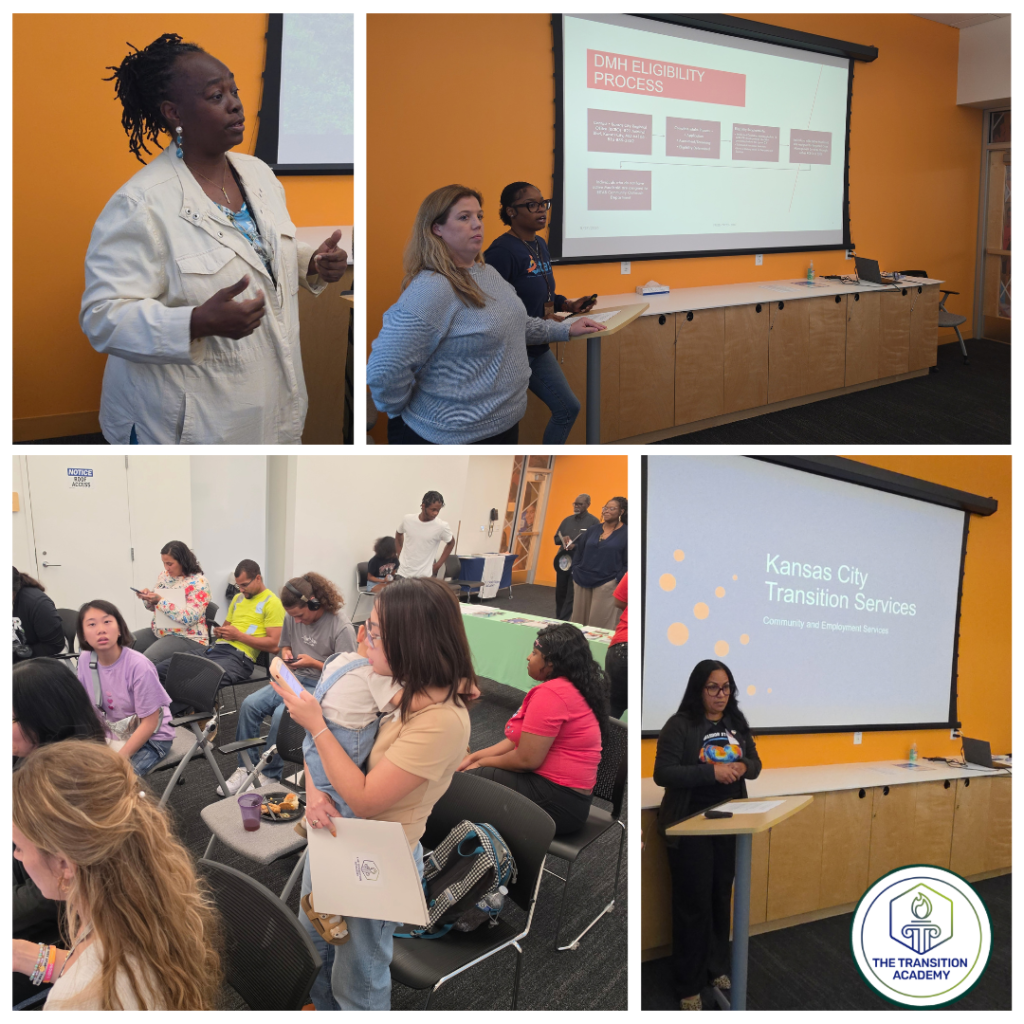
That’s why The Transition Academy recently brought five of Kansas City’s most important community support organizations together in one room for a family resource night. ReDiscover. EITAS. Center for Developmentally Disabled. Easterseals Midwest. Vocational Rehabilitation. Five organizations, back to back, sharing what they do, who they serve, and how to get connected. The full video is available on YouTube or linked below and we encourage you to share with others who need this information.
The Takeaway
Every presenter in that room said some version of the same thing: the system is complicated, but you don’t have to figure it out alone. Call someone. Ask the question. Show up. And if one organization can’t help you, they’ll point you to someone who can.
The full recording of this session is available on TTA’s YouTube channel. Share it with a family who needs it.
ReDiscover: Mental Health Supports in Eastern Jackson County
ReDiscover is a mental health and substance use treatment organization serving Eastern Jackson County – Lee’s Summit, Raytown, South KC, Grandview, and parts of Kansas City. They work hard to remove every possible barrier between a family and care.
They embed therapists directly in schools. They have mobile crisis units. They answer the 988 mental health crisis line. They have peer support specialists for both youth and adults. And they’re opening Kansas City’s first urgent care mental health facility in Raytown, where families can walk in without an appointment and be seen the same day.
“If you make an appointment and it’s three to six weeks out, we will see you until your appointment comes up. We’re not going to say, ‘Oh, your appointment is two weeks away.’ We’re going to see you for those services.”
— Vanessa Hickman, ReDiscover
They also run the Pro Deo Youth Center, a free after-school program for high school students that includes tutoring, programming, and community outings serving students from 20 different schools. Transportation is a challenge for families outside Lee’s Summit, but that’s exactly what ReDiscover is working to change.
EITAS: Navigating the System So You Don't Have to Do It Alone
EITAS (stands for Empowering Individuals Through Advocacy and Support) is Jackson County’s developmental disability support services organization. They provide targeted case management, transportation, community outreach, and benefits navigation. But the most important thing they do might be this: they help families understand a system that, by everyone’s admission, is genuinely hard to navigate.
“It’s a confusing topic to navigate. To be honest, it is not easy. I’m still confused every day.”
— Jasmine McCrary, EITAS
But that is why they have specialists to help you navigate the maze. If your child has Medicaid, EITAS can connect you to a service coordinator who will help you access Medicaid waivers — funding streams that can cover residential services, personal care assistance, employment support, home modifications, and more. If your child doesn’t have Medicaid yet, EITAS’s Community Outreach Department exists specifically for you.
“These families were kind of sitting on the support coordinator’s caseload, and because they don’t have Medicaid waiver needs, they get pushed to the back burner. But they still need help with navigating and connecting through resources, figuring out what the next steps after high school are. That’s where we came in.”
— Catherine Donnell, EITAS
Their benefits specialist, Jennifer Seidel, can help families understand SSI, Medicaid, and ABLE accounts. Also, their transportation program is in high demand if you think you’ll need it, get on the list early.
Center for Developmentally Disabled (CDD): From Day Programs to Customized Employment
CDD offers a wide range of services: residential living, day habilitation through their Pals Three program, community networking, individualized skill development, ABA services, and employment support. What sets them apart is their philosophy.
They don’t just say no. They say “let’s figure out how we can make that happen.” That philosophy shows up in their approach to customized employment, one of only four organizations in the area offering this service. Customized employment means working with employers to carve out a specific role tailored entirely to what an individual can do and loves to do. Not finding a job and fitting someone into it. Building the job around the person.
“If you get a salad from somewhere and it has the dressing and silverware in a little bag — we can go to a restaurant and say, ‘Hey, we’ve got somebody who only needs 15 to 20 hours a week. Is there something your people groan about that they don’t want to do?’ And that could be something we customize that employment for.”
— Mindy Cooper, CDD
CDD also has individuals who work as parking attendants at Chiefs games. Across the street from Arrowhead. Real jobs, real wages.
Easterseals Midwest: Employment First, From Day One
Easterseals Midwest has been around for more than 100 years and serves individuals from birth through end of life. Their Kansas City operation covers day programs, community networking, individualized skill development, pre-employment services, summer work experience, and employment services all with one guiding philosophy.
“No matter what program you’re a part of, from our day program all the way through, we’re always focused on employment skills.”
— Kari Chester, Easterseals Midwest
Their RISE program — Reaching Independence and Successful Employment — is a six-to-twelve-month pre-employment program that works with individuals and community employer partners to build real workplace experience. And their results speak louder than any brochure.
One of their participants — a nonverbal young man, six foot four, who many had written off as unable to communicate — found his voice through the program. Staff discovered he could communicate by guiding someone’s hand to form letters. They moved him into RISE. He now works at a hotel, cleaning and turning over rooms, with a job coach by his side.
“He has learned that he absolutely loves working in a hotel. He has a voice. He has a choice. He has skills and he can earn an income.”
— Carrie, Easterseals Midwest
Easterseals also offers a summer work experience program for students 16 and up — paid, community-based, with a job coach — at sites like Union Station, the zoo, and more. Their Bridge Program takes community-based learning out of the classroom entirely, meeting individuals at coffee shops, libraries, museums, and local businesses to build real-world skills where life actually happens.
Vocational Rehabilitation: The Funding Source Behind Much of What You Just Read
If you’ve been wondering how all of these services get paid for, Vocational Rehabilitation is a big part of the answer. VR is Missouri’s state agency that funds employment services, job coaching, college and training programs, career assessments, summer work experience, and more for individuals with documented disabilities.
Here’s what families need to hear most: VR currently has no wait list. And employment services are free.
“There’s no cost to the family for our employment services.”
— Karen Dean, District Supervisor, VR Kansas City Downtown Office
VR’s transition counselor Kendra Hilthe works directly in 18 schools across the Kansas City metro — including Crossroads, Hogan, Ruskin, and others — meeting with juniors and seniors to help them plan for what comes after graduation. Summer work. College applications. FAFSA. Career exploration. Job placement. She does it all.
“When I get in the schools, the kids are like, ‘Hey, I heard you can help us get some money.’ Yes. Yes, I’m that person. Come see me.”
— Kendra Hilthe, Transition Counselor, Vocational Rehabilitation
VR can also help fund college at schools anywhere in the country, not just in Missouri as well as CDL training, welding programs, and other career pathways. They don’t put a time limit on their services. If it takes four to six years to finish a degree, they’re there.
Want to learn more about transition planning?
The Transition Academy has a Transition Checklist you can sign up for on our website. Plus the Greater Kansas City Guide to life after high school also has great information for planning for your next steps.
Visit our website:
The Transition Academy